ForgeCart
A multi-tenant e-commerce harness — many storefronts on one hardened platform. Catalog, checkout, subscriptions and an agentic admin, with AI woven through the stack so teams can run entire brands from a single system.
Commerce, reimagined as a platform
Commerce is one of the oldest ideas in business — the exchange of products and services between people. E-commerce is simply its electronic form: that same exchange, moved online. ForgeCart begins there, but it refuses to end there. It is not a page builder, and not a storefront template. It is a platform for building platforms.
That distinction is the whole thesis. The same foundation that runs a simple shop selling a handful of products can just as well become a bespoke logistics CRM coordinating many companies at once, an internal HR system, or a game studio's engagement platform — one that runs its own audience engine and rewards players through complex, looping reward mechanics. Entirely different businesses, built on one core.
ForgeCart is the flagship of Hohen Ventures, and it carries a single conviction: the next decade belongs to small teams who can operate like companies ten times their size — with AI treated as a first principle rather than a feature bolted on at the end.
The bets underneath it
- AI is the operating system, not an add-on — we wagered that intelligence belongs at the core of commerce, powering the admin and the storefront itself, not stapled on as a chatbot.
- One platform should carry many businesses — every tenant shares one hardened core with strict isolation, so launching the next storefront, CRM or internal tool costs a configuration, not a rebuild.
- Composability beats compromise — catalog, promotions, subscriptions, tax and fulfillment are modular by design, so each business assembles exactly the system it needs and nothing it does not.
- A platform is only as strong as what others build on it — a typed SDK and open admin and shop APIs mean other teams build their own products on ForgeCart, compounding its value beyond our own roadmap.
The thesis, made concrete
These are not mockups. Everything below is the platform running real brands today — the conviction, turned into product.
Merchants were flying blind. So we rebuilt the instrument panel.
Most commerce dashboards hand you the same fixed charts and hope they fit. We took the opposite view: every business runs on different signals, so ForgeCart lets teams compose their own metrics across sales and audience data — the numbers that actually decide how the business is run.

A storefront the whole team can shape — no engineers in the loop
We believed the people who understand a brand should be the ones shaping it. Workbench is a live map of the entire storefront — every page, every experiment, every piece of content — where a whole team works side by side, editing different sections at once without waiting on a release or an engineer.

And where change usually crawls, ForgeCart lets it fan out: kick off a spray and the platform spawns parallel agents, each taking one piece of content, so a site-wide overhaul lands together instead of queuing behind a single hand.

The entire commerce cycle, under one roof
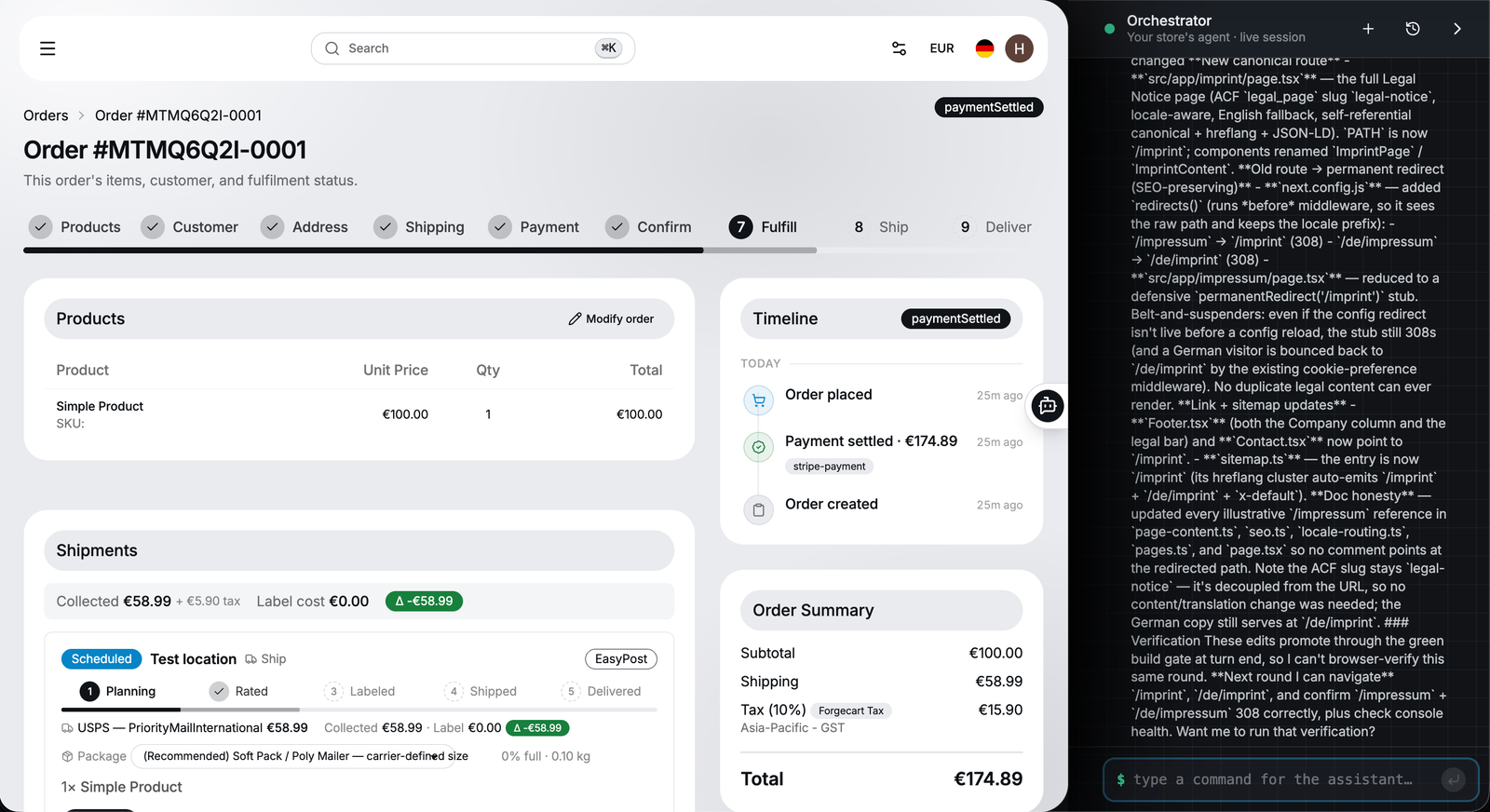
A sale does not end at checkout, so neither does the platform. Orders, fulfillment and compliant tax are first-class parts of ForgeCart — a purchase flows from cart to shipment to settlement without ever leaving the system, and without a patchwork of third-party tools to hold it together.
Every store is global on its own
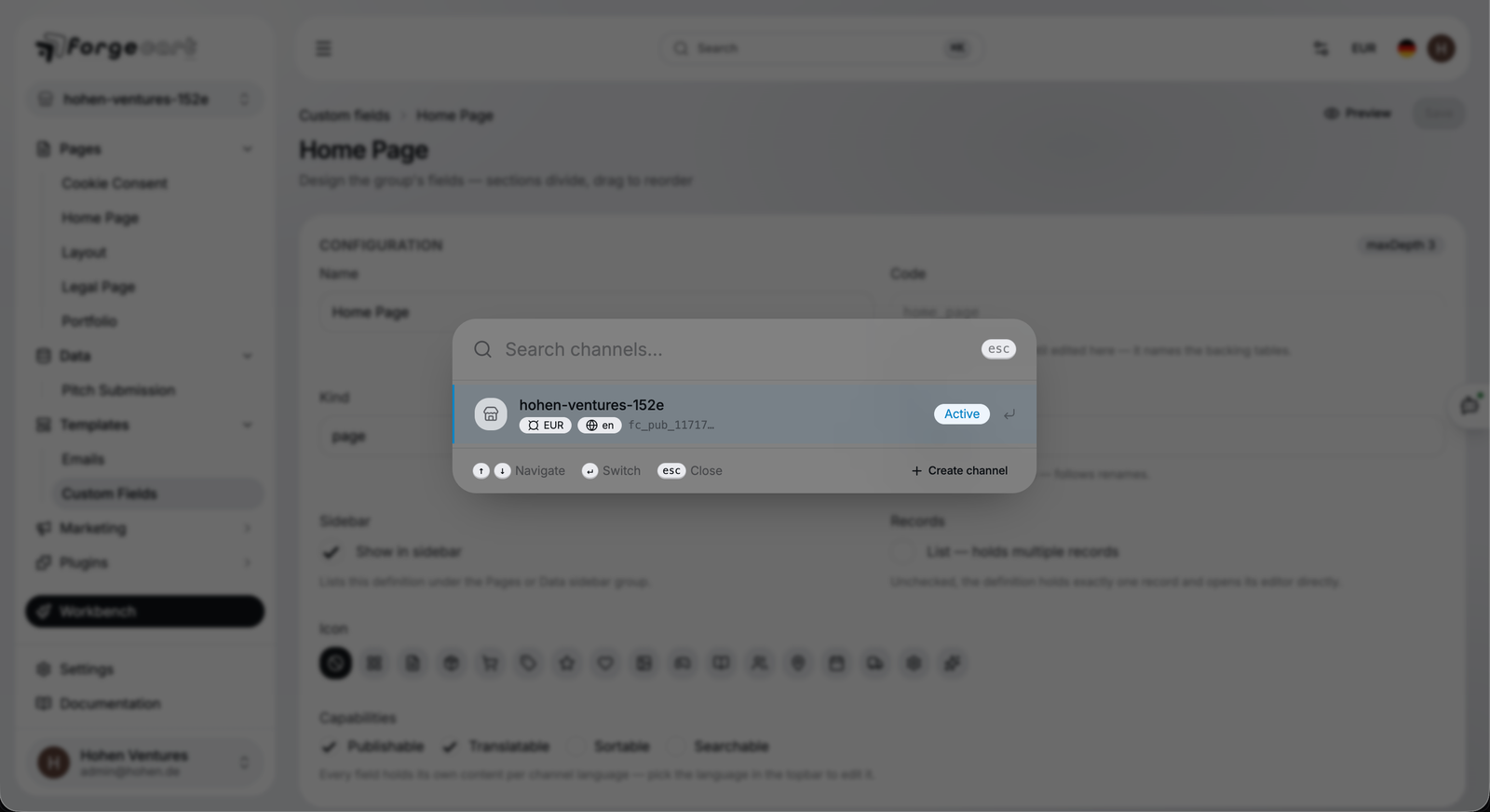
Reaching a new market should not mean standing up a new business. Each store is a single channel that carries as many languages and currencies as its markets demand — so one storefront serves the world natively, pricing and speaking to every customer in their own terms. And when a venture genuinely needs a separate brand, the platform runs it as another channel alongside the first: many stores, one core. Global reach is a setting, and a second store is a configuration — never a project.
Commerce isn't one-size-fits-all. Neither is the data beneath it.
No two businesses model their world the same way, so we refused to force them into ours. Custom Fields let teams define their own data structures, pages and dashboards on high-performance databases built into the platform — fast enough to store and query serious data against a schema they design themselves. It is the same capability that lets ForgeCart become a logistics CRM, an HR tool or a rewards engine, not just a store.
Why we're early — and why that's the edge
We are steering ForgeCart toward fully agentic operations, where reliable agents carry routine merchandising, support and growth work under clear guardrails. We are deliberately early here, because we believe the teams who learn to operate this way first will define what the next generation of companies looks like — and we are building the platform they will run on.